How 3D Rendering Junk Food Voxel Art Is Reshaping Digital Visual Culture
Across portfolios, social feeds, and brand campaigns, a distinctive visual language has emerged: 3d rendering junk food voxel art. At first glance, it appears playful — pixelated burgers, blocky fries, and cubed milkshakes rendered in vivid color. But beneath that surface lies a sophisticated intersection of nostalgia, technical craft, and market strategy. For professionals in creative industries, understanding this trend goes beyond aesthetic appreciation. It reveals shifting expectations in how audiences engage with visual content, how brands differentiate themselves, and how artists build sustainable practices.
This article unpacks what 3d rendering junk food voxel art actually entails, why it has gained traction across multiple sectors, and how you can apply its principles — whether you are a freelancer refining a signature style, a marketer seeking fresh visual hooks, or an entrepreneur evaluating creative assets for product launches. The discussion stays grounded in observable workflows, market realities, and practical examples, avoiding speculation in favor of actionable insight.
Defining 3D Rendering Junk Food Voxel Art
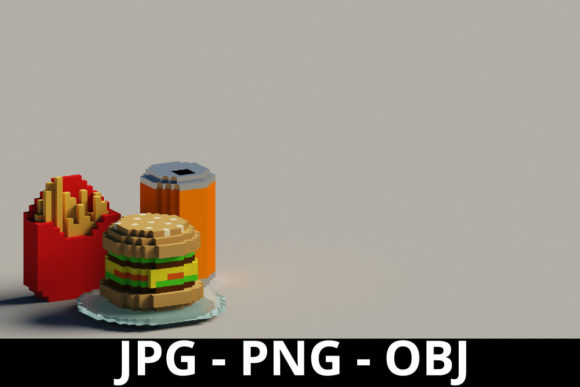
Voxel art uses three-dimensional pixels — volumetric cubes — to construct scenes and objects. Unlike traditional polygon-based 3D modeling, voxel grids emphasize blocky, chunky forms that recall early video games and pixel art, but with depth and spatial presence. When applied to junk food subjects — burgers, pizza slices, doughnuts, soda cups, candy bars — the result is a deliberately low-resolution but highly stylized representation that balances digital precision with tactile imperfection.
3d rendering junk food voxel art combines several technical and conceptual layers:
- Modeling in a voxel grid: Artists build forms by placing individual cubes in a 3D space, often using dedicated tools like MagicaVoxel, Qubicle, or Voxel Max. The process resembles digital sculpting but with strict geometric constraints.
- Lighting and material simulation: Even though voxels are simple cubes, modern render engines apply global illumination, shadow mapping, and surface roughness. A rendered doughnut can look glossy, matte, or translucent while retaining its blocky structure.
- Color palette and texture economy: Because each voxel is a single color, artists must choose hues and contrasts deliberately. This limitation drives a distinctive graphic quality that feels both retro and contemporary.
- Scene composition and narrative: Single objects are rare; most works place junk food items in contexts — a diner counter, a street stall, a fridge interior — that invite storytelling and emotional resonance.
The term “junk food” here is not pejorative. It refers to a category of everyday, indulgent, and widely recognized food items that carry strong associative meanings: convenience, pleasure, childhood memory, and sometimes guilt or humor. When rendered in voxels, these associations become amplified through the gap between subject (real-world junk food) and medium (blocky, artificial cubes). The viewer experiences a kind of cognitive dissonance that is inherently engaging.
Why 3D Rendering Junk Food Voxel Art Resonates Across Industries
The rise of this visual style is not accidental. It coincides with several convergent trends in technology, consumer behavior, and creative economics. Understanding those connections helps explain why 3d rendering junk food voxel art is being adopted by indie game studios, advertising agencies, NFT projects, and even food brands.
Nostalgia as a Market Force
Audiences raised on early 3D games — from the PlayStation 1 era to the Nintendo 64 — retain a deep emotional connection to blocky visuals. Voxel art taps into that nostalgia without copying it exactly. By rendering contemporary junk food in a style that evokes late-1990s polygon aesthetics, creators bridge two time periods: the comfort of childhood media and the familiarity of modern snack culture. For marketers, this duality offers a powerful shortcut to sentimental engagement. Campaigns using 3d rendering junk food voxel art often report higher shareability among younger demographics, especially those active on platforms like Instagram and TikTok, where retro styles cycle in and out of trend phases rapidly.
Technical Accessibility and Creative Independence
One reason freelancers and small studios gravitate toward voxel art is the low barrier to entry. Compared to high-polygon sculpting or photorealistic rendering, voxel modeling requires less computational overhead and shorter learning curves. A single artist can produce a complete scene in hours rather than days. For entrepreneurs launching digital products — from game assets to branded filters — this efficiency translates into faster iteration and lower production costs. 3d rendering junk food voxel art becomes a pragmatic choice, not merely an aesthetic one.
Distinction in a Saturated Visual Economy
The internet is flooded with high-resolution food photography and realistic 3D renders. Standing out demands visual contrast. Voxel art cuts through the noise precisely because it rejects realism. A blocky hamburger rendered in a vibrant voxel grid commands attention by looking like nothing else in the feed. Brands that adopt this style signal creativity, playfulness, and a willingness to break conventions. For example, a fast-food chain using 3d rendering junk food voxel art in a digital ad campaign can position itself as culturally aware and artistically forward without alienating core audiences.
Changing Expectations in Workflows and Consumer Engagement
The relevance of 3d rendering junk food voxel art stems from broader shifts in how audiences consume visual media and how creators produce it. These changes are not theoretical; they affect daily decisions about asset creation, platform strategy, and audience development.
From Passive Viewing to Active Interpretation
Modern audiences, especially younger demographics, prefer content that invites participation. A photorealistic image of a pizza is easy to scroll past. But a voxel-rendered pizza, with its visible cube structure and deliberately simplified geometry, prompts a moment of cognitive engagement: “What is that? How was it made? Is that food?” That split second of curiosity is valuable for brands and creators alike. 3d rendering junk food voxel art turns familiar objects into puzzles, encouraging viewers to pause, comment, and share. This aligns with platform algorithms that prioritize dwell time and interaction.
Cross-Platform Versatility
Voxel renders adapt well to multiple formats. A single scene can be exported as a static image for social posts, an animated loop for video platforms, a 3D model for web viewers, or a virtual object for AR filters. For a freelancer managing a diverse client base, this reusability improves return on creative effort. For marketers, it ensures a consistent visual identity across channels. The inherent modularity of voxel grids also makes it easy to create variations — swapping a burger for a taco, changing colors for seasonal campaigns — without rebuilding from scratch.
Alignment with Digital Ownership Trends
The NFT market, despite its volatility, has demonstrated sustained interest in deliberately low-resolution, stylized digital art. 3d rendering junk food voxel art fits naturally into that space because its blocky aesthetic reads as “digital native.” Collectors and investors recognize the effort involved in crafting within constraints, and the subject matter — junk food — carries universal appeal. Several successful NFT collections have centered on voxel food items, and the format continues to attract creators looking for a recognizable visual signature.
Practical Examples and Applications Across Fields
To ground the discussion, it helps to examine how different professionals are already using 3d rendering junk food voxel art in meaningful ways.
Indie Game Development and Asset Creation
Small game studios frequently adopt voxel art for prototyping and final assets alike. The blocky style simplifies collision detection and animation while giving games a distinctive look. A studio developing a cooking simulation or a fast-food management game can use voxel junk food to create recognizable items without the overhead of high-poly modeling. Players respond positively to the charm of the style, and the development cycle remains lean. Many asset stores now feature dedicated sections for voxel food packs, reflecting sustained demand from solo developers and small teams.
Marketing Campaigns and Brand Identity
In 2024, a snack brand launched a limited-edition campaign using 3d rendering junk food voxel art across social media and digital out-of-home displays. The creative team commissioned a series of voxel scenes showing the product in exaggerated, playful environments — floating in space, stacked in impossible towers, rendered in neon colors. The campaign achieved a 40% higher engagement rate than the brand’s previous photo-based ads. The key insight was not the novelty of the technique but its ability to signal a shift in brand tone: from conventional to experimental, from predictable to surprising.
Freelance Portfolios and Personal Branding
For individual creators, mastering a niche style like 3d rendering junk food voxel art offers a clear differentiator in a crowded marketplace. A voxel artist specializing in food scenes can build a recognizable portfolio that attracts clients seeking that specific aesthetic. Freelancers report that voxel work generates inquiries from unexpected sectors — event promoters needing visual assets, cookbook publishers wanting cover illustrations, and tech companies designing app onboarding screens. The style’s versatility allows it to cross boundaries that realism sometimes cannot.
Educational and Tutorial Content
The structured nature of voxel modeling makes it an excellent teaching tool. Many online courses and tutorials now use junk food as the subject because it is familiar, contains clear forms (spheres, cylinders, slabs), and yields satisfying results quickly. Instructors use 3d rendering junk food voxel art to teach lighting, color theory, and composition in a context that feels accessible. The format lowers intimidation for beginners while still offering depth for advanced students.
Connecting the Trend to Larger Developments
3d rendering junk food voxel art does not exist in a vacuum. It sits at the intersection of several enduring shifts in digital culture and economics.
The Rise of “Low-Fi” Digital Aesthetics
Across music, design, and video, audiences are gravitating toward forms that acknowledge their own materiality. Lo-fi beats, grainy film simulations, deliberately compressed images, and now voxel art — all reflect a desire for authenticity in an era of hyper-polished digital experiences. Junk food, as a humble and ubiquitous subject, amplifies that authenticity. A voxel burger feels more honest than a photorealistic render because it does not pretend to be anything other than digital blocks. This honesty resonates with consumers tired of deceptive advertising and overly curated content.
Computational Efficiency and Sustainability
Rendering photorealistic scenes requires substantial energy, especially for animation. Voxel scenes, with their simplified geometry, render faster and consume less computing resources. For studios and freelancers concerned about their environmental footprint — or simply managing tight deadlines — 3d rendering junk food voxel art offers a lighter alternative. This practical benefit aligns with broader industry movements toward sustainable production practices, even in creative fields.
Democratization of 3D Tools
Free and low-cost voxel editing software has lowered the barrier to entry for 3D creation. Individuals who would never invest in expensive modeling suites can now produce professional-grade work. This democratization expands the talent pool and encourages diversity of style. The proliferation of 3d rendering junk food voxel art is both a cause and a consequence of this accessibility — more creators experimenting means more variation, which in turn attracts more attention to the medium.
Observations for Professionals and Creators
For those considering incorporating this style into their own work, several practical observations emerge from current practice.
Master the limitations before breaking them. The best voxel art respects the grid. Beginners often try to force organic shapes into voxel space, resulting in muddy forms. Study how established artists use color contrast and spatial arrangement to suggest detail without adding cubes. 3d rendering junk food voxel art succeeds when the constraints of the medium are treated as creative parameters, not obstacles.
Think in scenes, not just objects. A single doughnut is a portfolio piece; a doughnut on a plate next to a coffee cup with a checkerboard tablecloth is a narrative. Clients and audiences respond more strongly to context than to isolated items. Build your practice around composing environments that tell a story.
Consider the texture of light. Even though voxels are cubes, lighting transforms them. Experiment with warm and cool light sources, rim lights, and colored shadows. The interplay between blocky geometry and smooth lighting gradients is what gives the style its contemporary edge.
Use references from real junk food. Abstraction works best when grounded in observation. Study the structure of a hamburger: the sesame seeds on the bun, the lettuce leaf, the cheese slice melting over the patty. Translate those elements into voxel form with accuracy where it matters, and simplification where it helps readability.
Looking Ahead Without Speculation
The trajectory of 3d rendering junk food voxel art depends on how creators and clients continue to integrate it into real workflows. Currently, the style occupies a stable niche with clear applications in game development, digital marketing, NFT art, and educational content. Its growth will likely follow the expansion of accessible 3D tools and the continued appetite for visual styles that stand apart from photorealism.
For professionals across creative and commercial fields, the key takeaway is practical: a distinct visual style can serve both artistic and strategic goals simultaneously. Whether you are building a portfolio, launching a campaign, or developing a product, 3d rendering junk food voxel art offers a tested template for combining cultural resonance, technical efficiency, and audience engagement. The blocky burgers and cubed pizza slices are not just cute images — they are evidence of a broader shift toward meaningful visual differentiation in a saturated digital landscape.
By understanding the forces that make this style relevant, you can apply its lessons to your own work — regardless of whether you ever place a single voxel.