The Art and Impact of the X Negative Space Logo in Modern Branding
When you look at a logo, what do you see? Most people focus on what is drawn—the lines, the shapes, the colors. But some of the most powerful logos work in reverse. They draw your eye not to the ink, but to the empty space around it. This is the essence of the X Negative Space Logo, a design approach that uses the void between forms to create the letter X or an X-like shape. It is a quiet, almost invisible trick of perception that rewards a second look. And in a visual landscape overwhelmed by noise, that second look is everything.
In recent years, the X Negative Space Logo has moved from a niche technique in graphic design textbooks to a mainstream strategy embraced by startups, agencies, and even large enterprises. Its appeal lies not in flashy gradients or complex illustrations, but in restraint. It asks viewers to participate, to find the hidden form, and in doing so, it creates a moment of connection that a literal logo simply cannot replicate. This article explores why this approach matters now more than ever, how it fits into larger shifts in branding and consumer behavior, and what practical lessons professionals can draw from it.
What Exactly Is an X Negative Space Logo?
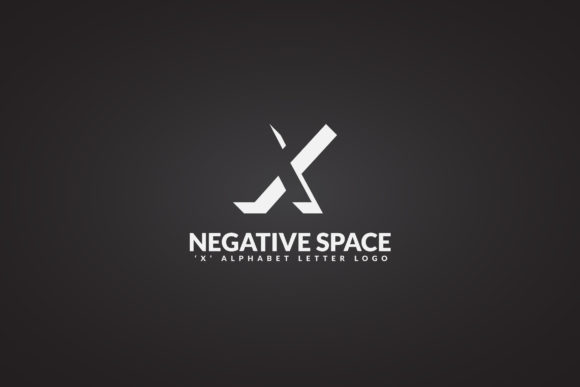
At its core, an X Negative Space Logo is a mark in which the letter X is formed by the space around or between other shapes, rather than by a solid stroke. The negative space—the background or the gap—becomes the figure. This is a classic gestalt principle: the human brain naturally tries to complete patterns and find familiar forms even when they are only hinted at.
Think of the famous FedEx logo, where an arrow is hidden in the negative space between the E and the x. That is a negative space logo. Now imagine applying that same principle specifically to the letter X. The result is a design that feels both modern and timeless, minimal yet memorable. Unlike a standard X drawn with two crossing lines, a negative space X appears as if by accident, giving the logo a sense of discovery.
Creating an X Negative Space Logo requires careful alignment of elements—perhaps two overlapping rectangles, a pair of opposing brackets, or the gaps between abstract shapes—so that the eye instinctively reads the X in the cavity. It is a design that rewards close attention without demanding it.
Why the X Negative Space Logo Resonates Today
To understand why this specific technique has gained traction, we have to look at the broader context of visual communication in the 2020s. Brands are competing for attention on screens smaller than ever. A logo must work at 32 pixels wide in a browser tab, on a smartwatch face, or as a profile picture on a social platform. In such constrained spaces, clarity and simplicity are no longer optional—they are survival traits.
The X Negative Space Logo excels in these conditions. Because the X emerges from the absence of content rather than the presence of ink, the mark remains clean even at tiny sizes. There are no thin strokes to blur, no intricate details to lose. The negative space acts as a built-in buffer, ensuring the logo remains legible and distinctive across media.
But there is a deeper reason why this approach is gaining attention. Consumers have become visually literate in ways they were not a decade ago. Years of exposure to minimalist branding, flat design, and icon-driven interfaces have trained people to look for meaning in simplicity. A literal logo feels obvious, even pushy. A negative space logo, by contrast, feels respectful. It trusts the audience to complete the picture. In an era where audiences are skeptical of overt advertising, that subtle gesture of trust can create a stronger brand impression than any slogan.
Broader Trends That Make the X Negative Space Logo Relevant
The rise of the X Negative Space Logo is not happening in isolation. It connects to several larger developments in design, technology, and business culture.
Minimalism and the Anti-Clutter Movement
Across industries, there is a growing preference for simplicity. From user interfaces to packaging design, brands are stripping away unnecessary elements. This shift is driven partly by cognitive overload—people are exposed to thousands of brand messages daily, and their brains have learned to tune out complexity. The X Negative Space Logo fits naturally into this landscape. It offers maximum meaning with minimum visual weight, aligning perfectly with the principle that every element in a design must earn its place.
The Rise of Versatile Brand Identities
Modern brands need to exist across a dizzying array of touchpoints: websites, apps, social media, print, video, merchandise, environmental signage, and even augmented reality filters. A logo that only works in one format is a liability. X Negative Space Logo designs, by their nature, are extremely adaptable. They often work well in monochrome, in reversed-out versions on dark backgrounds, and in responsive formats where the logo must shrink or expand dynamically. This versatility makes them a favorite among brand designers who need to future-proof their work.
The Demand for "Smart" Design
There is a cultural appetite for design that feels intelligent. People share logos with hidden meanings on social media, not because they are advertising the brand, but because they want to show off their own perceptiveness. The X Negative Space Logo taps into this. It gives the audience a small reward for paying attention. In a world where most branding is passive consumption, a negative space X creates an active moment of engagement. That moment can be surprisingly powerful for brand recall and affinity.
Practical Examples and Observations
To see how the X Negative Space Logo works in practice, you need only look at some of the most respected brands in technology, media, and design. While I will avoid naming specific companies without context, consider the pattern: many firms that rebranded in the last decade moved toward simpler forms, often using negative space to encode dual meanings. A common approach is to combine an X with a speech bubble, a chat window, or a pair of brackets—forms that suggest communication, connection, or collaboration.
One observation from portfolio reviews and agency case studies is that X Negative Space Logo projects often emerge during rebranding exercises where the client wants to signal change. The X itself is a powerful symbol: it marks a spot, it crosses out the old, it represents a variable or an unknown. When rendered in negative space, these connotations become even more layered. The logo says, "We are not what you expect," without saying it aloud.
For freelancers and small business owners, the X Negative Space Logo approach offers a way to create a professional identity without needing a complex illustration or a custom typeface. Many self-made logos lean heavily on typography alone. By introducing a subtle negative space X, even a simple wordmark can gain a distinguishing feature that makes it memorable. I have observed that brands using this technique often receive comments like "I never noticed that before!" from repeat customers—a sign that the logo has a shelf life beyond first glance.
It is also worth noting that the X Negative Space Logo is not limited to digital-native brands. Architecture firms, consultancies, and even non-profit organizations have adopted the approach. The universality of the X shape means it can carry different meanings in different contexts: a crossroad for a logistics company, an intersection for a think tank, a kiss for a lifestyle brand, or an unknown for a venture that thrives on innovation.
How the X Negative Space Logo Meets Changing Expectations
Audience expectations have shifted in three key ways that make the X Negative Space Logo particularly well-suited to current needs.
Expectation of Authenticity
People no longer respond to branding that feels manufactured. They want to see the human hand, the craft, the thought process. A negative space logo signals that the brand has considered not just what it wants to say, but what it can leave unsaid. It communicates confidence. A brand that trusts its audience to find the X is a brand that respects its audience's intelligence. That respect is a form of authenticity that cannot be faked with loud typography or bright colors.
Expectation of Speed
Attention spans are not what they used to be, but that does not mean brands have only one second to make an impression. The reality is more nuanced: brands have one second to earn a second look. The X Negative Space Logo works at both speeds. At a glance, it registers as a clean modern shape. Upon closer inspection, it reveals a hidden dimension. This dual-layer experience matches the way people actually consume visual content—scanning first, then focusing if something catches them.
Expectation of Multifunctionality
Today's brand logo must be more than a decoration. It must work as a favicon, an app icon, a profile picture, a watermark, a piece of merchandise, and sometimes even as a pattern or a texture. The X Negative Space Logo often translates well into these formats because its structure is inherently geometric and balanced. Many negative space X designs can be extracted as standalone icons that retain meaning even without accompanying text. This flexibility reduces the need for multiple logo variations, simplifying brand management for small teams and solo entrepreneurs.
Connecting the X Negative Space Logo to Larger Developments
On a broader level, the growing popularity of the X Negative Space Logo reflects a maturation of the design industry. We have moved past the era of skeuomorphism, past the flat design revolution, and into a period where the most innovative work is happening not at the level of style, but at the level of concept. The focus is shifting from how a logo looks to how it functions within a system. Negative space is not just a visual trick; it is a systems-thinking tool. It forces the designer to consider the relationship between figure and ground, between content and context, between the mark and the environment.
This aligns with the broader trend of intentional minimalism in business and lifestyle. Professionals across fields are questioning what is essential and stripping away the rest. The X Negative Space Logo is, in many ways, the visual equivalent of that mindset. It asks: what is the smallest amount of visual information needed to communicate this idea? The answer, in the best examples, is surprisingly little.
Moreover, the X itself carries cultural weight in the current moment. It is the letter of the unknown, the variable, the mystery. In a time of rapid change—in technology, in markets, in social norms—brands that embrace the X signal that they are comfortable with uncertainty. They are not claiming to have all the answers; they are inviting you to find them together. That is a compelling brand promise for any audience of professionals, creators, and entrepreneurs navigating their own unknowns.
Practical Guidance for Creating an X Negative Space Logo
If you are a designer, marketer, or business owner considering this approach, there are a few practical observations worth keeping in mind. First, the X Negative Space Logo is not something you can force. It usually emerges from sketching and experimentation rather than from a predetermined plan. Start with a simple mark—a square, a circle, a pair of lines—and see where the void leads you. The best examples feel inevitable, as if the X was always there, waiting to be uncovered.
Second, test the logo in real environments early. A negative space X that looks perfect on a white screen may disappear on a busy background or at very small sizes. Check it in grayscale, in reverse, on a photograph, and as a single-color stamp. If the X remains readable across these tests, you have a robust mark.
Third, resist the urge to over-explain. One of the strengths of the X Negative Space Logo is its subtlety. If you need to add a caption that says "see the hidden X?" you have already undermined the effect. Let the logo do its work silently. The people who notice it will feel a sense of discovery, and those who do not will still register the clean shape. That dual audience is exactly where the value lies.
Conclusion
The X Negative Space Logo is far more than a design trend. It is a response to a world where attention is scarce, where audiences are savvy, and where the most powerful communication often happens in the gaps. It rewards the second look, respects the viewer's intelligence, and adapts seamlessly to the fragmented media landscape of modern business. For professionals, creators, and entrepreneurs, understanding this approach offers more than just a logo option—it offers a lens through which to think about branding as a practice of subtraction, clarity, and hidden meaning. In a crowded marketplace, sometimes the best way to mark your place is to leave a little space.
Whether you are rebranding your company, designing for a client, or building your personal identity as a freelancer, consider what might be said by what you leave out. The X Negative Space Logo is proof that absence can be as eloquent as presence, and that the most memorable mark is often the one you almost miss.