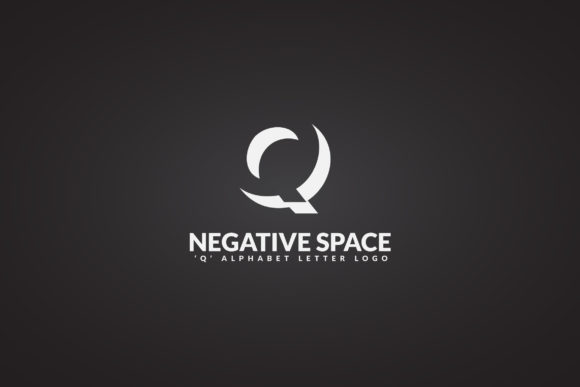
Q Negative Space Logo
You’ve seen them before—logos that make you stop and smile because they hide a second shape in plain sight. A Q negative space logo does exactly that: it takes the letter Q and turns the empty area inside or around it into something else, often an arrow, a leaf, a speech bubble, or even a whole object. The trick is that the Q keeps its recognizable tail and circle, while the white space tells a separate story. People in branding love this approach because it rewards a second look and feels clever without screaming for attention.
When a Q Negative Space Logo Makes a Statement
Practically speaking, the Q negative space style shines in industries that value subtle confidence. Think about a tech startup named “Quantum” or “Quik”—they want to communicate speed, intelligence, and modern thinking. A simple Q with an arrow formed in the negative space can say “forward motion” without needing a separate icon. I’ve seen this work beautifully for SaaS companies: the logo sits in a small browser tab, and even at 16 pixels, the arrow inside the Q still reads clearly because the contrast is strong.
Creative agencies and design studios also gravitate toward this technique. They use the Q to hint at their specialty—a paintbrush in the negative space for a branding firm, or a camera lens for a photography studio. The audience is usually other creatives who appreciate the inside joke, and that builds instant rapport. In my experience, when you hand a business card with a Q that hides a camera, the recipient immediately tries to figure it out, and that interaction sticks.
Music artists and podcasters have adopted negative space logos too, especially if their name starts with Q or has a Q in it. The negative space can form musical notes, headphones, or sound waves. Since these audiences often see the logo on album art, merch, or social media profiles, the hidden element gives them something to share and talk about. It’s free word-of-mouth marketing.
Educational platforms or language learning apps sometimes use a Q negative space logo to represent “question” or “query.” The inside of the Q becomes a speech bubble or a question mark. For an app like “Quizzy” or “Q&A,” that visual link is immediate. Users associate the logo with curiosity and answers, which is exactly the feeling you want before they even open the app.
Even automotive or engineering brands with a Q in their name can use the negative space to suggest gears, wheels, or compass points. A Q with a compass arrow inside speaks to navigation and precision—great for a logistics company. The practical benefit is that you don’t need a separate icon; the Q itself carries all the meaning.
Different Audiences, Different Reasons to Choose It
Designers themselves love the Q negative space logo because it’s a creative puzzle. As a designer, you get to explore how much you can strip away before the Q becomes unrecognizable. That exercise is valuable for your portfolio, and it shows future clients that you can pack meaning into simple shapes. For a freelancer starting out, landing a client who wants this style can be a career highlight—you end up with a case study that demonstrates both conceptual thinking and technical execution.
Business owners who are not designers often choose this approach because it feels sophisticated without being abstract. Many entrepreneurs I’ve spoken to say they wanted a logo that “looks like nothing else out there,” but they also need it to work on a storefront sign and a mobile app icon. The Q negative space logo delivers that range. It reads as a letter (so it’s safe and familiar) but the hidden shape adds a layer of uniqueness. For a coffee shop called “Quench,” a Q with a droplet formed inside immediately suggests thirst and refreshment. Customers get it in a split second.
Marketers and brand strategists see this style as a tool for brand recall. A logo that hides a second image is easier to remember because the brain has to work a tiny bit harder to decode it—that effort actually improves memory. In a crowded market, a Q negative space logo can be the difference between a visitor scrolling past and stopping to think, “Wait, what’s that inside the Q?”
The Fine Line Between Clever and Confusing
Before you run off to sketch your Q, it’s worth understanding where this approach can trip you up. The biggest challenge is legibility at small sizes. If the negative space shape is too detailed, it becomes a blob when the logo is scaled down to a favicon or a social media profile picture. I’ve seen logos where the inside of the Q looks like a fish at high resolution but turns into a smudge at 32 by 32 pixels. Always test at the smallest size you plan to use.
Another consideration is cultural reading. While a Q is fairly universal, the shape inside might mean different things in different regions. For example, a checkmark inside the Q could be interpreted as “approved” in Western markets but might look like a foreign symbol elsewhere. If your brand plans to expand globally, get feedback from people in those markets before finalizing.
Also, think about the brand personality. A Q negative space logo tends to feel modern, minimalist, and a bit intellectual. That’s perfect for a consulting firm or a design studio, but maybe too cold for a children’s toy brand or a cozy bakery. The negative space approach can feel sterile if the brand voice is supposed to be warm and playful. In those cases, adding a hand-drawn texture or a slight curve to the Q can soften the look without losing the cleverness.
Another often-overlooked point: don’t force the hidden shape if it doesn’t fit naturally. I’ve seen logos where the designer tried to hide a complex object inside the Q, and the result is a shape that doesn’t look like a Q anymore. The letter itself becomes distorted, and the logo loses its immediate readability. If people can’t tell it’s a Q at a glance, the negative space trick is wasted.
Strengths That Keep This Style Popular
Even with limitations, the Q negative space logo has lasting appeal because it achieves so much with so little. One strong point is versatility across media. The same logo works on a white background, a black shirt, or a full-color website header—the negative space does the heavy lifting. You don’t need gradients or special effects; just a solid shape and the void inside.
Another strength is that it feels timeless. Trends come and go, but negative space logos have been around for decades. FedEx’s hidden arrow is probably the most famous example, and it still looks fresh. The Q version follows that same logic. When you use negative space to create meaning, the logo doesn’t rely on a specific illustration style that might date itself in five years.
I’ve also observed that this style encourages deeper brand engagement. People love to point out the hidden element to friends—“Look, the Q has a microphone inside.” That kind of sharing is gold for small businesses. It turns a static logo into a conversation starter.
A Few Things to Watch Out For
On the flip side, one practical limitation is that the Q negative space logo can become a cliché if it’s overused. You’ll see many startups with a Q that contains an abstract swoosh or a generic arrow. If your hidden shape doesn’t have a clear connection to your brand story, it might look like you just copied a trend. Always ask yourself: does this negative space shape mean something specific to my business, or is it just decoration?
Color choice also matters more than you might think. The negative space effect relies on contrast between the Q shape (the filled area) and the background. If you use a busy background or a low-contrast color, the hidden shape disappears. That’s why most Q negative space logos stick to black, white, or a single accent color. If your brand uses multiple colors, you might need a simplified monochrome version just for the logo to work correctly.
Another potential issue is that the tail of the Q can interfere with the negative space shape inside. The tail often extends from the bottom right of the circle, and it can visually crowd the inner area if the hiding shape is placed low. Designers sometimes solve this by making the tail very subtle, or by moving the tail outside the circle entirely—but then it might not read as a Q. Getting that balance right usually takes several iterations.
Finally, consider how the logo will be used in animation. Many brands now have animated logos for video intros or loading screens. Animate the hidden shape fading into existence inside the Q can be stunning—but it also requires careful planning. The static version needs to work perfectly on its own before you add motion.
All in all, a Q negative space logo is not just a design gimmick. It’s a practical choice for brands that need to be memorable across every touchpoint, from a business card to a billboard. Whether you are a startup founder looking for an edge, a designer expanding your portfolio, or a marketer trying to boost brand recall, the Q negative space logo offers a way to pack meaning into a single letter without overwhelming the viewer. The key is to treat the hidden shape as an extension of your brand story, not an afterthought. When you get that right, you end up with a logo that feels both inevitable and surprising—and that’s exactly what you want people to think when they see your Q.